Alexandra Willis
Prix François Masson
Alexandra Willis est une artiste franco-anglaise, née à Londres et basée à Paris.
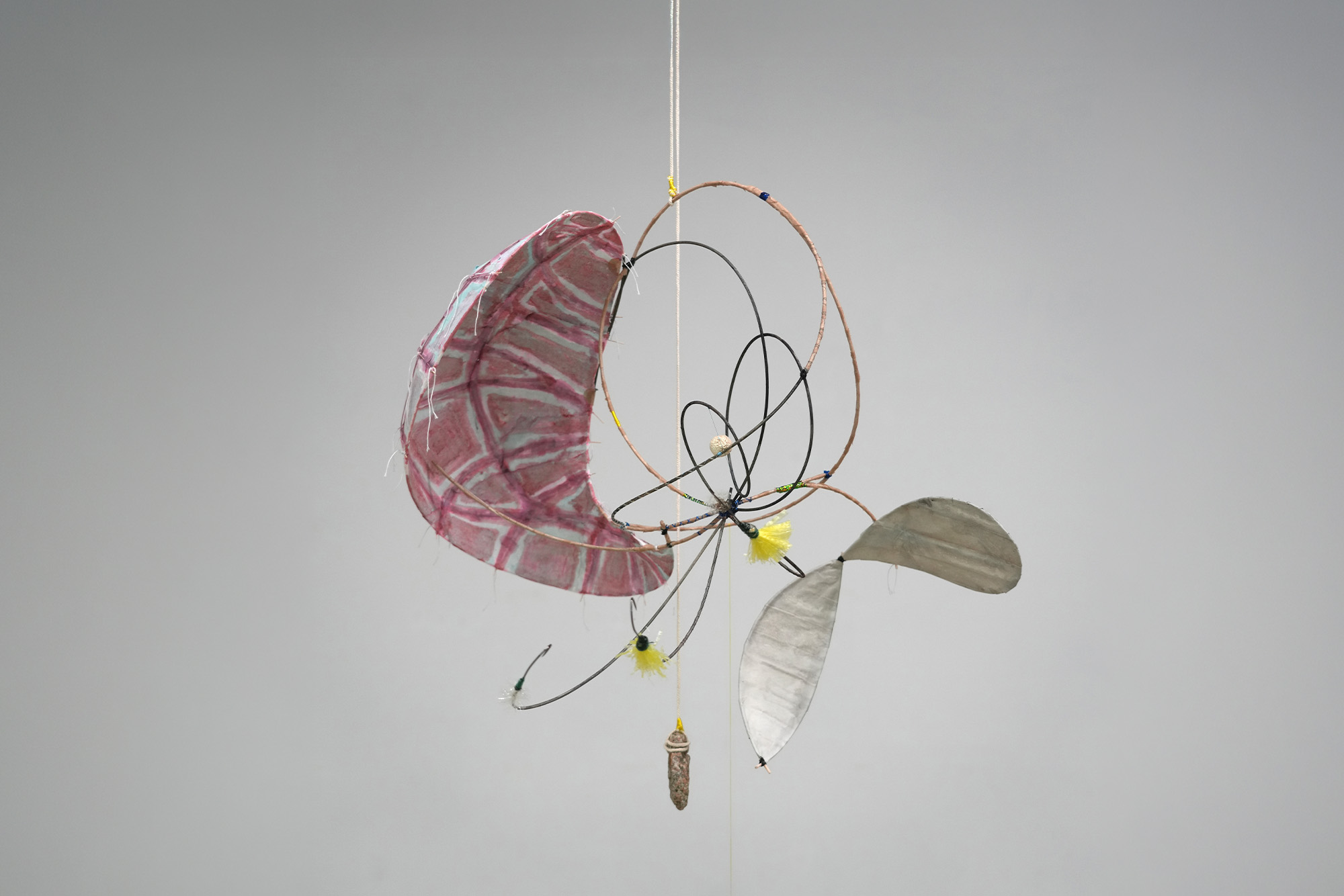
Après avoir obtenu, en 2021, un Master en Chimie avec les félicitations du jury à l’Université d’Oxford, elle poursuit ses études aux Beaux-Arts de Paris, où son parcours scientifique continue de nourrir ses recherches artistiques. Sa pratique englobe la sculpture, l’installation, la performance et le dessin, et s’ancre souvent dans une exploration des notions de tension, d’équilibre et des systèmes invisibles qui façonnent l’expérience humaine.
Son travail met en scène des espaces où coexistent des oppositions : légèreté et gravité, liberté et contrainte, en nous invitant à réfléchir aux structures qui façonnent notre expérience et aux systèmes qui, à la fois, nous relient et nous contraignent. Elle s’intéresse particulièrement à la fugacité de ces équilibres et à la manière dont ils organisent le chaos apparent du monde.
Fascinée par les pièges passifs, les saddle points et la notion de « faire visage », elle puise dans ces formes d’organisation instables et ambiguës une source d’inspiration essentielle. Ces états de bascule, où attraction et échappée coexistent, nourrissent une recherche sur les seuils, les tensions latentes et les manières dont les formes émergent au regard.
Alexandra Willis is a Franco-British artist, born in London and based in Paris.
After obtaining a Master’s degree in Chemistry with first-class honours from the University of Oxford in 2021, she continued her studies at Beaux-Arts de Paris, where her scientific background continues to inform her artistic research. Her practice encompasses sculpture, installation, performance and drawing, and is often rooted in an exploration of the notions of tension, balance and the invisible systems that shape the human experience.
Her work creates spaces where opposites coexist – lightness and gravity, freedom and constraint – inviting us to reflect on the structures that shape our experience and the systems that both connect and constrain us. She is particularly interested in the transience of these balances and the way in which they organise the world’s apparent chaos.
Fascinated by passive traps, saddle points and the notion of ‘putting on a face’, she draws on these unstable and ambiguous forms of organisation as a key source of inspiration. These states of flux, where attraction and escape coexist, inform her exploration of thresholds, latent tensions and the ways in which forms emerge to the eye.