Soumis par Anonyme le

Welcome to the Translation Management Tool Demo module!

The Translation Management Tool (TMGMT) demo module provides the configuration needed for translating predefined content types - translatable nodes.

It enables three languages. Besides English, it supports German and French.

Content translation is enabled by default. This allows users to translate the content on their own. Also, Export / Import File translator enables exporting source data into a file and import the translated in return.

  • To get started with the translation, two translatable nodes are created. The steps for translation are the following:
    • On the node detail view use the "translate" Tab, choose a language and click "Request Translation" to get started.
    • After submitting the job, the status is changed to "In progress". In case of a machine translator, the translation is immediately returned. The status is then "Needs review".
    • "In progress" is the state where we are awaiting the translations from the translator.
    • Once the translations are provided by the translator, we can review the job items (and correct) the translated content. Some translators support feedback cycles. We can send an item that needs a better translation back to the translator with some comments. If the translation is fine, we can accept the job items (or the job). This is when the source items are updated/the translation is created.
    • The job is finally in the state of being published
  • In the TMGMT demo module the File translator is enabled by default. It allows users to export and import texts via xliff and HTML. The workflow is the following:
    • Submit a job to the File translator. The job is in "active" state.
    • Export it as HTML/XLIFF format.
    • Translate the content by editing the XLIFF files in plaintext or with a proper CAT tool.
    • Import it back on the site.
    • Review the job items/data items. XLIFF does not support a feedback loop or commenting an item. Improvements/fixings can only be done by the reviewer (or by reimporting the improved XLIFF).
    • Press save as completed to accept the translation and finish the process.
  • In the TMGMT demo module the Drupal user provider is also enabled by default. It allows to assign translation tasks to the users of the site that have the abilities to translate it (The demo adds all the abilities to all the users). The workflow is the following:
    • Submit a job to the Drupal user provider and select translator for the job. The job is in "active" state.
    • The user will translate the task. Also the task items can be reviewed.
    • When the translation is done, the user will set the task as completed.
    • Review the job items. This translator does not support a feedback loop or commenting an item. Improvements/fixings can only be done by the reviewer.
    • Press save as completed to accept the translation and finish the process.

TMGMT demo also supports translation of paragraphs. To do this, you first need to enable paragraphs_demo and tmgmt_demo after that.

Les Beaux-Arts de Paris participent aux Journées européennes du patrimoine 2026, venez découvrir nos bâtiments classés au titre des monuments historiques et les trésors qu’ils renferment !

Une journée exceptionnelle pour explorer les lieux emblématiques de l’École en visite libre ou guidée : la cour d’honneur, la Chapelle des Petits-Augustins, la cour du mûrier, l’amphithéâtre d’honneur, la bibliothèque d’art contemporain et l’amphithéâtre de morphologie.

Inscription jusqu'au 14 septembre 2026

La filière « Fresque & Art en situation » des Beaux-Arts de Paris s’adresse aux artistes en cours d’études dès la 3e année aux Beaux-Arts de Paris ainsi qu'aux titulaires d’un bac +3 (DNA, licence en arts plastiques, DNMADE, DNSEP) au 1er octobre 2026 ou justifiant de 3 ans au moins d’expérience professionnelle dans le monde artistique.
 

Dessin, peinture, photographie, modelage… Offrez-vous des cours aux Beaux-Arts de Paris !

La Nouvelle Académie des Amateurs (NABA) est animée par des artistes sélectionnés pour leur maîtrise technique et leur connaissance de l'art ancien et contemporain.
Le programme riche et dynamique, associe recherche thématique et ouverture aux expressions les plus contemporaines.

Développez vos compétences artistiques dans un lieu emblématique qui abrite l’une des plus prestigieuses écoles d’art d’Europe.

Les Beaux-Arts de Paris participent aux Journées européennes du patrimoine 2026, venez découvrir nos bâtiments classés au titre des monuments historiques et les trésors qu’ils renferment !

Une journée exceptionnelle pour explorer les lieux emblématiques de l’École en visite libre ou guidée : la cour d’honneur, la Chapelle des Petits-Augustins, la cour du mûrier, l’amphithéâtre d’honneur, la bibliothèque d’art contemporain et l’amphithéâtre de morphologie.

À première vue revient cet été et donne carte blanche aux galeries de Saint-Germain-des-Prés pour exposer dans leurs vitrines les œuvres des jeunes artistes diplômés des Beaux-Arts de Paris.

Souhaitant accompagner les jeunes artistes de l’École, le cabinet international d’avocats d’affaires Gide a développé un partenariat avec les Beaux-Arts de Paris.
Ainsi, chaque année, un appel à projet à destination des étudiants et jeunes diplômés est lancé pour la création de films courts en vidéo ou en 3D et 4 lauréats sont sélectionnés par un jury auquel participent les avocats associés du cabinet.
Leurs œuvres sont acquises et diffusées au siège de Gide à raison d’un artiste par trimestre, sur de grands écrans Led de 120 x 240 cm. 

1 /

Mathieu Santori-Lamberti

Prix des Amis

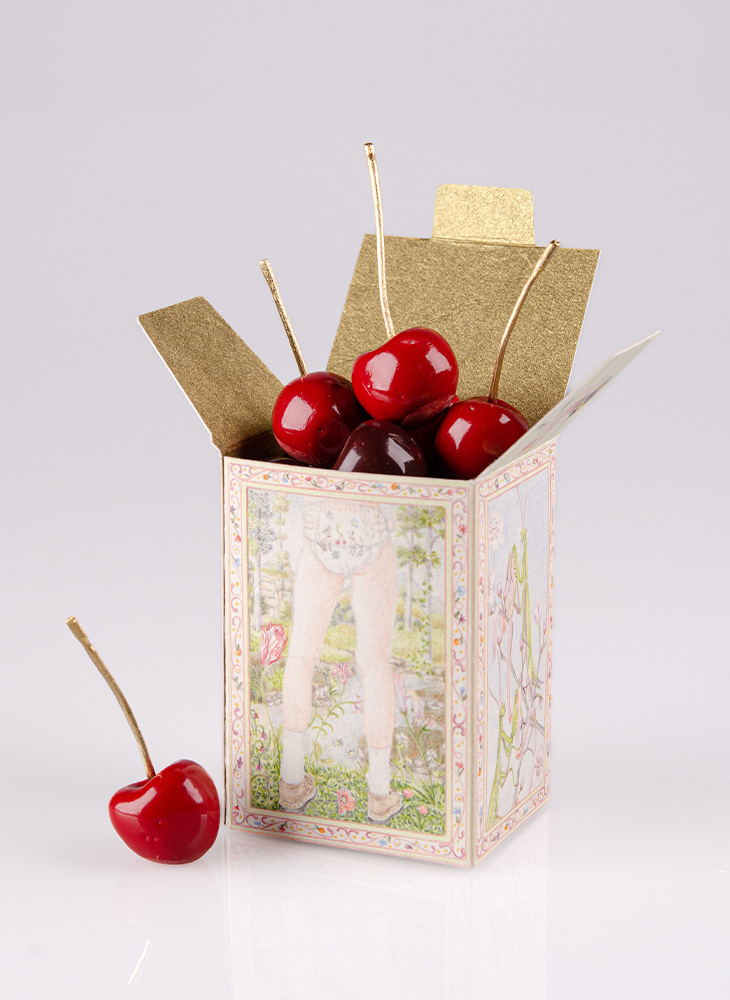
La pratique de dessin de Mathieu Santori se déploie sur papier japonais, papier peint, bois ou encore en volume. L’érotisme parcourt l’œuvre de l’artiste.  Il s’incarne dans le geste, les formes, les couleurs et les sujets, révélant la sensualité de la technique. La délicatesse de son trait rentre en tension avec l’étrangeté des scènes. L’artiste nous plonge alors dans un sentiment ambiguë, entre séduction et répulsion. Son travail en volume prend la forme d’objets, de boîtes. Ses « dessin-volumes », fabriqués de toutes pièces ou bien restaurées, délivrent, renferment et protègent. Ces objets de désir jouent sur la notion d’interdit. Le papier peint, support récurent dans sa pratique, suggère l’intérieur domestique et l’intériorité mentale. Rêves, souvenirs, réalité et fantasmes ne font plus qu’un.


Mathieu Santori’s drawing practice spans Japanese paper, wallpaper, wood and three-dimensional works. Eroticism runs through the artist’s work. It is embodied in the gesture, the forms, the colours and the subjects, revealing the sensuality of the technique. The delicacy of his line stands in contrast to the strangeness of the scenes. The artist thus immerses us in an ambiguous feeling, somewhere between seduction and repulsion. His three-dimensional work takes the form of objects and boxes. His ‘three-dimensional drawings’, whether crafted from scratch or restored, deliver, enclose and protect. These objects of desire play on the notion of the forbidden. Wallpaper, a recurring medium in her practice, evokes the domestic interior and the inner mind. Dreams, memories, reality and fantasies become one.