On 11 March 2011, Japan was shaken by the Fukushima disaster of unprecedented magnitude. What have we learned from this inextricably natural and nuclear disaster?
To discuss its echoes and resonances beyond Japan and "from our window", philosopher Clélia Zernik, curator Élodie Royer, researcher in film theory and aesthetics Élise Domenach, and writer Michaël Ferrier, who share a deep knowledge of the Japanese art scenes with which they maintain a long-standing dialogue, look back on this event and the upheavals it has caused.
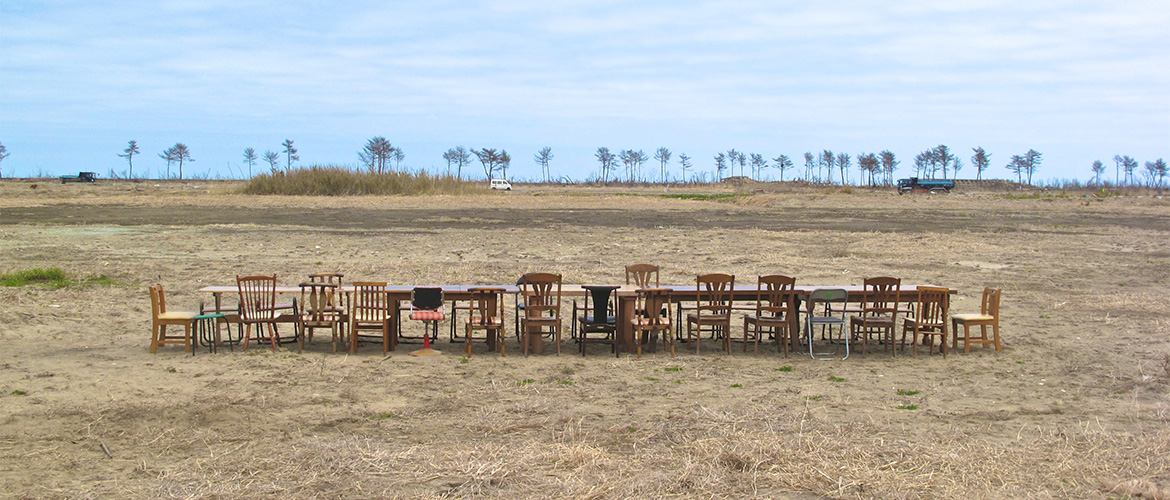
From the fine arts and the actions that followed the disaster, initiated by certain artists and workshop leaders such as Jean-Luc Vilmouth, who organised a banquet in the vicinity of Fukushima with a community of survivors one year after the events, from Japan as experienced by Michaël Ferrier in his book Fukushima, a story of disaster seen through the prism of cinema, or from La Hague or Rokkasho, focusing on pollution and other health risks to the environment and populations, there arises "the question of a permanently damaged world that requires us to develop new capacities for attention and presence in the world", as Élise Domenach points out in her book Le paradigme Fukushima au cinéma (The Fukushima Paradigm in Cinema).
Meeting with Clélia Zernik, Élise Domenach, Élodie Royer and Michaël Ferrier, moderated by Audrey Illouz.
In partnership with ENS Louis-Lumière and with the support of the Institut Universitaire de France.
Élise Domenach is a professor at ENS Louis-Lumière and a senior member of the Institut Universitaire de France. A graduate of the École Normale Supérieure, she holds an agrégation and a doctorate in philosophy. She is the author of Stanley Cavell, le cinéma et le scepticisme (2011) and L’écran de nos pensées. Stanley Cavell, le cinéma et la philosophie (ed., 2021). She has published numerous studies on the cinema of the Dardenne brothers, Malick, Desplechin, American, Japanese and Taiwanese eco-cinema, Lav Diaz, Wang Bing and Hamaguchi, as well as two books on Japanese cinema: Fukushima en cinéma. Voix du cinéma japonais/ Fukushima in Film. Voices from the Japanese Cinema (2015) and Le Paradigme Fukushima au cinéma. Ce que voir veut dire (2011-2013) (2022). She also writes as a film critic for Esprit and Positif.
Michaël Ferrier is a writer and professor at Chuo University in Tokyo. As a direct witness to the disaster, he has written and edited numerous collective works on Fukushima: Fukushima, récit d'un désastre (Gallimard, 2012), Penser avec Fukushima (2016), Dans l’œil du désastre : créer avec Fukushima (Thierry Marchaisse, 2021), as well as texts from "the atom trilogy", produced by Watanabe Kenichi and published under the title Notre ami l’atome (Gallimard, 2021). The recipient of several literary, theatrical (Festival d'Avignon) and film (International Uranium Film Festival) awards, he is also the creator of the website tokyo-time-table.com
Élodie Royer is an independent curator based in Paris. Since her residency at Villa Kujoyama in 2011, she has been working continuously with the Japanese art scene. Her exhibitions and writings focus on the interactions between art and the environment, exploring in particular ecological narratives and artistic practices in Japan in the wake of the triple disaster in Fukushima. She recently curated the exhibition L’Écologie des relations (FRAC Sud, Marseille, 2026) and co-curated its first part, L’Écologie des choses (Maison de la culture du Japon, Paris, 2025). Since this year, she has been teaching at the École Duperré and serving as a member of the scientific council of the LaM, Lille Métropole Museum of Modern Art, Contemporary Art and Art Brut.
A graduate of the École Normale Supérieure, Clélia Zernik holds an agrégation and a doctorate in aesthetics and is a professor of philosophy of art at the Beaux-Arts in Paris. Her early research focused on the relationship between art and science, as developed by art psychologists and phenomenologists (see Perception-cinéma, Vrin, Paris, 2012; L’œil et l’objectif, Vrin, 2014). Her research now focuses on cinema (Les Sept samouraïs d’Akira Kurosawa, Yellow Now, Paris, 2013, L’attrait du café, Yellow Now, Paris 2017, L’attrait du fantôme, Yellow Now, Paris, 2019) and contemporary Japanese art, thanks to study visits to Waseda University and the University of Tokyo. She works on the question of the doubling of images (Japanese surfaces and depths) and regularly contributes to magazines such as Critique d'art and Art Press.
Crédit photo : © Jean-Luc Vilmouth, Lunch Time, 2014