Artistic Practice Department
The Artistic Practice Department encompasses thirty-three studios under the responsibility of artist-professors. A place of practice, for artistic creation and experimentation, the studio is also a space for debate, exchange, and criticism. At certain times of the year, it transforms into an exhibition space, notably during diploma and evaluation periods. Under the guidance of a renowned artist, the studio is a space for training, where students of all levels, from 1st to 5th year, work together, often using multidisciplinary creative techniques. Combining personalized attention and the collective dimension of exchange, the objective of the teaching within the studio is to encourage each student’s artistic commitment, helping them to build their own artistic language.
Technical Skills Department
Technical courses offer extensive training in working with traditional and modern materials, and with digital tools in particular. Managed by artists and art technicians, the technical studios enable students to expand their personal work to new fields and consider its development through the mastery of different mediums, to make material obstacles to their creation disappear.
Printing and Multiples Department
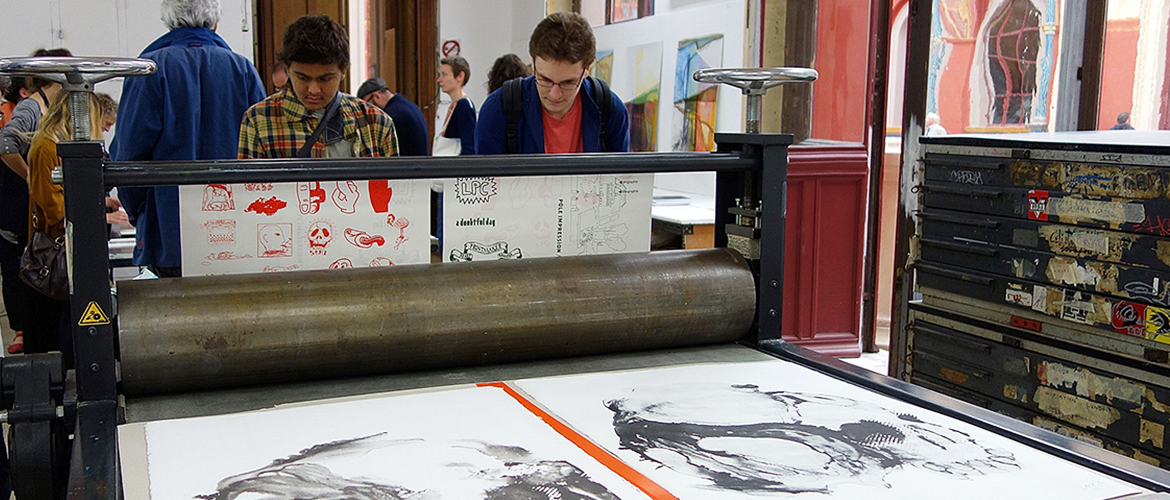
The Printing and Multiples Department brings together the studios of Wernher Bouwens, Aurélie Pagès, and Julien Sirjacq. The courses intersect in their commitment to publishing in its broadest space, opening a space for reflection and experimentation around printed art, publishing, and the production of multiples. From traditional practices to new technologies, publishing’s various areas are as numerous as the possibilities of its practices, uses, and experiments. The center is organized collegially, though each professor has developed their own approach publishing and printing.
Material/Space Department
The Material/Space Department Space groups the fresco, mosaic, molding, carving, and painting technique studios, as well as the material /space laboratory, created with a view to cross-disciplinarity.
Drawing Department
The teaching of drawing, compulsory in 1st and 2nd years, is available to all students during their studies. At once an account of what is seen, a tool for analysis, an instrument for reflection, a blueprint, and a project, drawing is important in the conception of a work, but can also be considered as a work in its own right. The four drawing professors offer very different approaches: from analytical drawing based on models, to drawing from the imagination, including experimental drawing around traces, imprints, signs, and writing.
Theoretical Study Department
The Beaux-Arts de Paris trains artists whose practice is constantly informed by a wide range of theoretical issues that fall within both the artistic and extra-artistic spheres. This integration of the theoretical
dimension is an integral part of artistic practice and is characterized by constant methodological innovation and new forms of intellectual exploration. From the undergraduate to the graduate level, a comprehensive curriculum enables students to engage with both art history and numerous disciplines—
literature, philosophy, film, and other fields ranging from the natural sciences to the humanities. It takes various forms: from lectures to workshops and seminars, among others. Theory permeates the program not only through dedicated courses but also within workshops and technical training, as well as through numerous exchanges in the context of exhibitions and interdisciplinary projects.
The Department of Theoretical Studies is a fundamental pillar of the program. Students are encouraged to meet with theory instructors throughout the course of study to discuss their practice.
Language Department
Language teaching offers students the chance to master a necessary tool in the globalized world, but above all, it is an opportunity to experience otherness within the creation of meaning and explore the limits of the untranslatable and the richness of other ways of speaking, of other ways of looking. Other perspectives are opened through languages, and they play an important role in international engagement, and are vital for 4th year travels.
Photo: © Adrien Thibault