Studios
The Department of Artistic Practices comprises thirty-three studios led by artist-teachers. The studio is a place for artistic practice, creation, and experimentation. It is also a space for debate, discussion, and critique. At certain times of the year—particularly during graduation or evaluation periods—it transforms into an exhibition space.
Led by a renowned artist, the studio is the primary setting for education, where students of all levels—from the 1st to the 5th year—work together, most often using multidisciplinary creative techniques. Combining personalized attention with a collective spirit of exchange, the pedagogical approach within the studio aims to foster each student’s artistic engagement by helping them gradually develop their own personal artistic language.
Technical courses
Technical courses offer extensive training in working with traditional and modern materials, with a broad focus on digital tools. Led by artists or art technicians, these technical workshops enable students to broaden the scope of their personal work and envision its development through mastery of various media, thereby breaking down the material barriers to their creativity.
These workshops serve as complementary technical supports to the work carried out in the artistic practice studio.
Starting in the second semester of the second year, students take technical courses, which they choose based on their artistic practice. The technical course units are offered in the Department of Printmaking and Publishing, the Department of Material and Space, and the Department of Technical Foundations.
Drawing
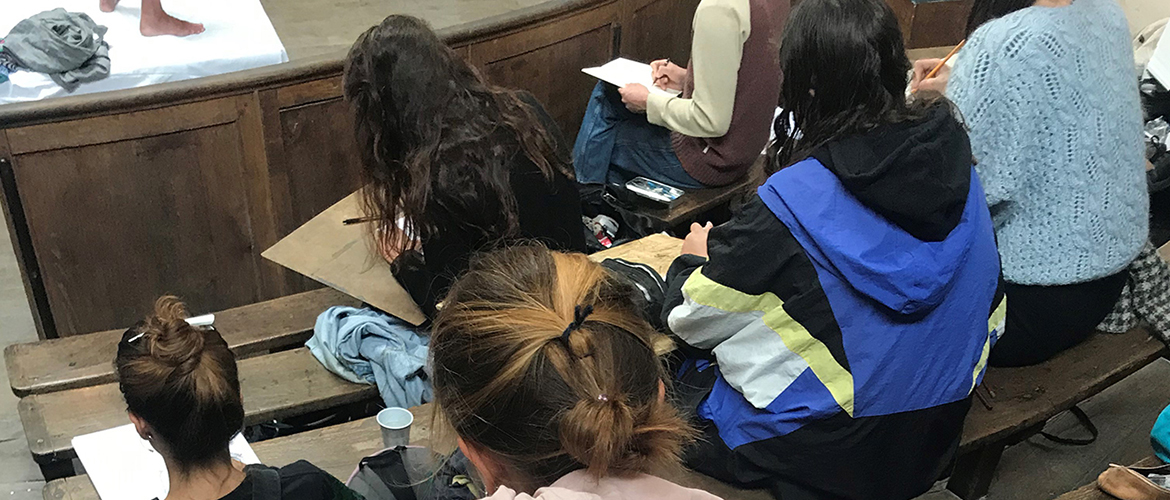
Drawing is considered a cross-disciplinary component of studio practice. Serving as a record of what is seen, a tool for analysis, a means of reflection, a sketch, or a design, it plays a major role in the creation of a work of art, but can also be considered a work of art in its own right. This
course is required in the 1st and 2nd years.
Art Theory and History / Research Seminars
Courses in art theory and history are designed to support students from their first through third years, through weekly classes that enable them to acquire a set of fundamentals needed to navigate the history of art and its interpretations with confidence, grasp contemporary issues, contextualize their own practice, and refine their critical perspective. However, this does not mean simply taking courses organized academically by period or movement; rather, it aims to equip students with the tools to engage critically with the arts of all eras and origins in support of their evolving artistic practice.
The 4th- and 5th-year research seminars allow students to explore specific topics in greater depth. The research seminar is a space for critical reflection, intellectual production, and theoretical experimentation. It supports students’ artistic development by situating it within a framework of in-depth research. Its goal is to structure and deepen their personal artistic projects from a research perspective.
The Practice of Hanging and Exhibiting
The school des Beaux-Arts de Paris serves as a hub for numerous and diverse exhibitions, held at varying intervals, which enrich the life of the school—from educational exhibitions in the studios, the right and left galleries, and the spaces in the glass-enclosed courtyard, to exhibitions by graduating students. This regular exhibition schedule throughout the year is an integral part of studio instruction and allows students to situate their work within a spatial context, in relation to other artworks (whether by fellow students or from the School’s collections), and to explore the issues at stake.
The exhibition halls of the Palais des Beaux-Arts on Quai Malaquais, meanwhile, host a curatorial project dedicated to the previous year’s graduating artists. Entrusted to guest curators, this project offers young artists their first encounter with a professional critical eye while introducing the public to the most promising expressions of emerging art. Renewed each year with unique curatorial approaches, the exhibition is divided into three sections and serves as a platform for showcasing the emerging art scene emerging from the Beaux-Arts de Paris, where the sensibilities, questions, and forms that will help shape tomorrow’s contemporary art are taking shape.
The Cabinet des Dessins et Estampes – Jean Bonna is the venue where the Beaux-Arts de Paris presents, in a focused and demanding format, thematic exhibitions primarily devoted to its collections. Conceived as laboratories for observation and knowledge, these exhibitions—held twice a year—highlight rarely seen collections while exploring the questions raised by contemporary art and the school’s educational approach. They regularly combine scientific research, public outreach, and student participation, making the Jean Bonna Department of Drawings and Prints a unique space for dialogue between heritage, education, and artistic creation.
Access to the Collections and the Library
With nearly 450,000 works of art and heritage publications, the collections of the Beaux-Arts de Paris represent an immense heritage, inherited from the Royal Academies and regularly expanded until 1968 through the works of its students (including the famous Prix de Rome, among others), as well as through the acquisition of educational models and exceptional donations made to support the training of artists.
These collections thus serve as a resource for students, faculty, and researchers, acting as a source of inspiration, a basis for reflection, scientific material, or works available for exhibition projects.
The contemporary art library offers a rich, up-to-date, and freely accessible collection of resources on contemporary art and its context. Open Monday through Friday and featuring 80 seats, it also supports students throughout their studies by offering workshops on research tools and presentations of materials related to current events in the art world and at the Beaux-Arts de Paris.
The documentary resources of the Collections Department and the Contemporary Art Library can be explored on the Alexandrine portal: alexandrine.beauxartsparis.fr.
Cultural Programming
Closely tied to current events and educational projects, exhibitions, and publications, the “Penser le Présent” cultural program is developed based on proposals from the School’s faculty, workshops, departments, and centers, as well as from students.
Open to all disciplines, “Penser le Présent” reflects current artistic and cultural trends, fostering encounters, critical tours, workshops, and debates with artists, critics, arts professionals, theorists, and practitioners across all fields of intellectual expression.
Research
Research activities at the Beaux-Arts de Paris are rich, diverse, and valuable for advancing knowledge of art history and the visual arts: from research seminars to doctoral programs within SACRe; from research workshops on themes explored in heritage exhibitions; to collaborations between artistic practices and cutting-edge research in chemistry and engineering within technical facilities; and projects that develop a philosophy of gesture within the studios. These numerous ambitious projects, with their highly diverse approaches, contribute to making the Beaux-Arts de Paris a unique and innovative research hub.
In its commitment to fostering a multifaceted approach to research and promoting its value, the School relies on the Research Council, which involves the institution’s various research communities. The Council first highlights existing activities and then develops new research synergies through a collaborative approach that permeates all of the institution’s activities. In this context, in December 2025, the Research Council approved an initial research focus area titled “Extractivist Legacies.” Materials, techniques, and artistic imaginaries are deeply intertwined with—often invisible—logics of extraction, ranging from natural resources to digital data. These dynamics, historically rooted in industrial and colonial processes, continue to shape our relationship with the world amid an ecological crisis.
Extractivism—understood as extraction, transformation, and displacement—also involves symbolic, cultural, and epistemic dimensions. This research focus thus aims to critically explore these legacies, spanning memory, creation, and future perspectives.
International
Thanks to the diversity and quality of its partners, the Beaux-Arts de Paris offers a wide range of international programs and experiences: study trips, workshops, exhibitions, and more.
International mobility is an integral part of the fourth-year program. Students have the opportunity to spend a semester abroad, either through an academic exchange at a prestigious or unconventional art school, or through an international professional internship.
Visiting Professor 2026–2027: Jill Mulleady
Each year, the Beaux-Arts de Paris invites an international artist-professor as part of its visiting professor program. This program consists of an invitation to an artist to occupy an art studio for one year. The visiting professor is hosted through the Institut français x Cité internationale des arts residency program. This program is open to artists and cultural professionals residing abroad who wish to develop a research and creative project in Paris. Each year, the Institut français welcomes more than 70 residents from around the world and across all artistic disciplines to the Cité internationale des arts.
For the 2026–2027 academic year, the Beaux-Arts de Paris is delighted to welcome Jill Mulleady.
Photo: © Alexis Micallef